The Great Painters
Andrzej Wróblewski
- patron of rebellious artists

PROTEST PAINTER
CULT FIGURE
SOCIALIST REALIST PAINTING
CINEMATOGRAPHY OF THE IMAGE
Andrzej Wróblewski (1927-1957)
Andrzej Wróblewski
1927
On 15 June in Vilnius, Andrzej Wróblewski, son of Krystyna (a talented graphic designer) and Bronisław (professor of law at the Stefan Batory University in Vilnius, where he served as rector four times) was born. The Wróblewski House was a meeting place for Vilnius artists. Under the supervision of his mother, Andrzej Wróblewski made his first attempts at drawing. The illustrations to historical novels by Gąsiorowski and to "With fire and sword" included horses, hives, Cossacks. As a token of appreciation, a friend of the house Wojciech Kossak (1856-1942) gave the little artist his own drawing of a horse's head.
1941
On 26 August, during a brutal Gestapo search at the Wróblewski home, Andrzej's father dies of a heart attack in front of his 14-year-old son. This tragic experience has marked him for life and influenced his later work.
1945
in a group of repatriates from Vilnius, together with his mother and older brother Andrzej Wróblewski came to Krakow in the spring, passed his baccalaureate exams in July, and in the autumn started studying at the Faculty of Painting at the Academy of Fine Arts and at the same time studied art history at the Jagiellonian University
1947
six-month stay in the Netherlands, travel in Europe
1948
Diploma in Art History at the Jagiellonian University, his work entitled "The beginnings of landscape in Dutch art of the fifteenth to seventeenth century" was rated very high, but Andrzej Wróblewski did not decide on a scientific career. He watched with curiosity a group of older colleagues, gathered around Tadeusz Kantor (1915-1990) and eagerly joined the preparations of the 1st Modern Art Exhibition

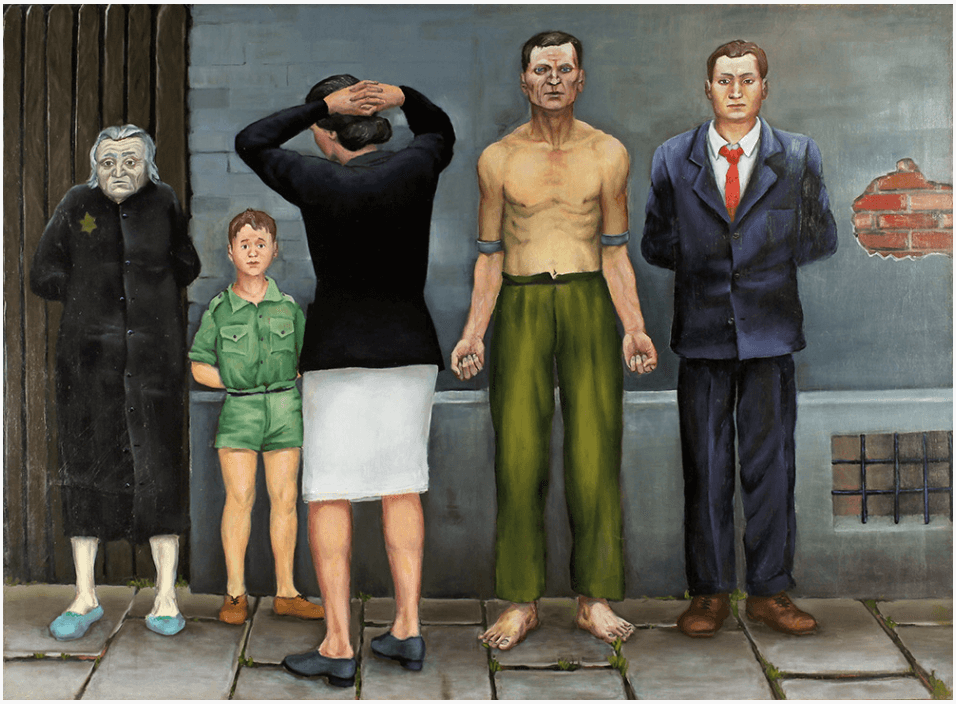
Andrzej Wróblewski, "Szofer niebieski", 1948 / "Liquidation of the ghetto", 1949, oil on canvas, private collection, source: https://culture.pl/.
1949
he painted "Shootings"
1950
he started working as an assistant at the Faculty of Painting of the Academy of Fine Arts
1950-1953
This is the worst dark period in the painter's work and life. He has managed to argue with almost the entire community: The "modern" people from Kantor's circle considered him a traitor, the professors considered him a predatory, primitive doctrinaire.
1953
Andrzej Wróblewski married Teresa Reutt, a graduate of philosophy and classical philology, whom he met on holiday. This outstanding woman with a strong personality had a great influence on him. Soon they had three children (a son and two twins).
1956
The trip to Yugoslavia became a big event for Andrzej Wróblewski, he once again discovered primitive, folk art there, he was also impressed by the original sculpture of Serbian gravestones. After his return to the country, he seemed full of energy, as if he had regained faith in himself again. That year, he painted "Ecupations", and his first solo exhibition took place in Warsaw's Salon "Simply". It was organised by the artist's friend, Andrzej Wajda, who at that time stood on the threshold of his international film career.
1957
In spring, Andrzej Wróblewski goes on a trip to the Tatras. On March 23rd foresters found his body by the road to Morskie Oko. The immediate cause of death was probably an attack of epilepsy. The tragic death of Andrzej Wróblewski contributed to the growth of the legend of Wróblewski - a lonely, rebellious artist.
Interesting facts:
The other side of the picture
Andrzej Wróblewski often painted on both sides, out of savings. For example, on the back of "Sky" there is a blue, realistic tram.
"The emotional content of the revolution
The painting by Andrzej Wróblewski "The emotional content of the revolution" was selected by Kantor and hung over the entrance to the exhibition. According to the witnesses, he was supposed to be a transmitter of the idea of the 1st Modern Art Exhibition.
Chauffeur on the right
In the picture "Blue chauffeur" the chauffeur's seat is on the right side, which made interpreters think. But here Andrzej Wróblewski was a realist. After the war a lot of English cars from the demobile were driving in Poland, where the steering wheel was placed on the right side.
Mice
"Shootings in Poznań" was painted for the Festival of Art Schools in Poznań. The painting did not like it, and even became an object of aggression - someone cut a figure of a Jewish old woman with a knife. The destroyed canvas lay for 45 years rolled up in the basement, damp and bitten by mice. They were found by the employees of the Bumper Gallery, commissioned maintenance and made available to the public.
Wajda
Andrzej Wajda, who called Andrzej Wróblewski his spiritual leader, showed his paintings in many of his films: "Shooting"in "Love of twenty-year-olds" (1962), "A picture about the horrors of war"in "Lotna" (1959), and in the film "Everything for Sale" (1968) the main character visits the entire exhibition of Wróblewski. The artist's name does not appear on the screen, however, but only the wife who accompanies the protagonist comments: "I have seen these pictures. So cruel". One could say that Andrzej Wróblewski's international, although as yet unsigned, presence begins at this very moment - on the screens of prestigious film festivals to which Andrzej Wajda's films were invited.
Movie
A short film about Andrzej Wróblewski "Opening and Closing Eyes" was made in 1957 by Konrad Nałęcki (director of many films about art and creator of the cult series "Four Armored and a Dog"). "We chose poems and the title together with Tadeusz. (...) I knew the kinship between Różewicz's poetry and Andrzej's painting - I decided to combine them. But it was only on the screen that I saw this strange concordance and identity of content myself" - Konrad Nałęcki at the conference in Rogalin in 1967.

About the art of Andrzej Wróblewski:
He was able to paint lyrical, subtle abstractions, but also ugly, cruel, "well as the smell of a corpse" - as he said himself. Years later these canvases have the power and beauty of generalization in them. "Shootings" - this is one of the most shocking testimonies of the time of war; "Glorifications"- a clear metaphor of a degraded, incapacitated reality. The example by Andrzej Wróblewski teaches that in art there are sometimes matters more important than beauty and subtlety of form. The artist was deeply convinced that the aim of art is to change the world, to influence the recipient.
- Andrzej Wajda (1926-2016), colleague of Andrzej Wróblewski
"Blue chauffeur" is one of the most beautiful, most poignant paintings by Andrzej Wróblewski. Visible in the interior of the blue chauffeur, the driver is driving through a deserted, dead landscape: out of the window you can see snowy fields under a red sky and a road that runs endlessly. A silent chauffeur driving through a dead landscape pulls us along; unwillingly, we follow him - like him, hypnotically looking at the horizon. He is like a mysterious guide, a contemporary Charon, who takes us to the other side...
– Jerzy Stajuda
Andrzej Wróblewski's favourite technique was gouache: watercolour mixed with opaque white, giving the effect of a subdued, pastel colour range. Apart from oil paintings, the artist left over 1500 gouaches, watercolours, drawings and monotypes. The works on paper were not only a kind of an intimate notebook, "a humble observation of life", as he said - but also a kind of laboratory of form. Another technique forced quicker decisions, allowed for colour and composition experiments. In these works you can see the whole workshop of the painter, the ideas and concepts recorded "hot".
"Ukrzesłownienie (Chairs)" - neologism calls to mind "crucifixion", it is a suggestion of martyrdom. Meanwhile, the theme of the painting is simple expectation. The life in the gray, cruel reality of the Polish People's Republic appeared to Andrzej Wróblewski as a gigantic, nationwide waiting room; a vestibule where ordinary people have been assigned the role of eternal supplicants, where one has to wait for something all the time, and where humble patience gains a dimension of heroic virtue.
– Kinga Kawalerowicz
Andrzej Wróblewski is a legend in Polish art. The tragic death, the conflict with the world and the paintings, which cannot be forgotten, have been conducive to the creation of the cult of the painter. His work was referred to by successive generations of artists, the "Nowa Figuracja" group, the WPROST group, and in the 1990s the Warsaw "Gruppa" group, e.g. Jarosław Modzelewski (born 1955). Andrzej Wróblewski impresses with his radicalism, passion, but also talent and ability to control the form.
– Andrzej Osęka
– Ignacy Witz
Andrzej Wróblewski in Museums:

Warsaw: National Museum. You can admire there, among others..:
- "Heaven" painted in 1948
- „Ziemia” namalowany w 1948
- „Szofer” namalowany w 1948
- „Rozstrzelanie surrealistyczne” namalowany w 1949
- „Rozstrzelanie na ścianie” namalowany w 1949
- „Poczekalnia – bogaci i biedni” namalowany w 1949
- „Fajrant w Nowej Hucie” namalowany w 1954
- „Matki” namalowany w 1955
- „Kolejka trwa” namalowany w 1956
- „Pranie” namalowany w 1956
Poznań: National Museum. You can admire there, among others..:
- „Plaża” namalowany w 1955
- "The emotional content of the revolution namalowany w 1948
- „Szofer niebieski” namalowany w 1948
- „Rozstrzelanie I” namalowany w 1949
- „Rozstrzelanie z chłopczykiem” namalowany w 1949
- „Dworzec na ziemiach odzyskanych” namalowany w 1949
- „Głowa z literami” namalowany w 1957

Russia:
- Moscow: Pushkin Museum
Krakow: National Museum - Archive of the Academy of Fine Arts - Zderzak Gallery - Historical Museum. The cities of Krakow. You can admire there, among others..:
- „Niebo nad górami” namalowany w 1948
- „Zatopione Miasto” namalowany w 1948
- „Zatopione miasto – studium” namalowany w 1948
- „Człowiek-Abstrakcja” namalowany w 1948-49
- „Dziecko z zabitą matką” namalowany w 1949
- „Matka z zabitym dzieckiem” namalowany w 1949
- „Rozstrzelanie poznańskie” namalowany w 1949
- „Kitek i ludzie” namalowany w 1955-56
- „Muzeum” namalowany w 1956
- „Kitek przy oknie” namalowany w 1956
- „Ukrzesłowienie” namalowany w 1956
- „Głowa mężczyzny” namalowany w 1957
Other Polish cities:
- Gorzów: Wielkopolskie Muzeum Okręgowe. Można tam podziwiać m. in.:
- „Głowa mężczyzny na czerwonym tle” namalowany w 1957
- Katowice: Silesian Museum. You can admire there, among others..:
- „Abstrakcja geometryczna szara” namalowany w 1948
- Lublin: Muzeum Można tam podziwiać m. in.:
- „Obraz na temat okropności wojennych” namalowany w 1948
- Łódź: Muzeum Sztuki. Można tam podziwiać m. in.:
- „Słońce i inne gwiazdy” namalowany w 1948
- „Zakochani” namalowany w 1959-57
- Radom: District Museum. You can admire there, among others..:
- „Sklepikarz” namalowany w 1949
- Toruń: Muzeum Okręgowe. Można tam podziwiać m. in.:
- „Nagrobek kobieciarza” namalowany w 1956
- Wrocław: National Museum. You can admire there, among others..:
- „Cień Hiroszimy” namalowany w 1957
- Bydgoszcz: Muzeum Okręgowe
Andrzej Wróblewski (1927-1957)
- PROTEST PAINTER: 100%
- CULT FIGURE 100%
- SOCIALIST REALIST PAINTING 95%
- CINEMATOGRAPHY OF THE IMAGE 100%