The Great Painters
Piotr Potworowski
- rebellious colourist

Piotr Potworowski (1898-1962)
The world and the restless spirit, on a journey from Post-Impressionism to abstraction, visited many countries and landscapes. His paintings are a painter's "travel diary": an unusual, synthetic vision of the climates and places he sees. The last stage of his art is a wonderful synthesis of the Polish landscape. He is one of the artists whose art is still vividly received by young artists, for whom he is not only an inspiration, but also a kind of model.
EMINENT COLOURIST
LANDSCAPIST
INNOVATIVE SCENOGRAPHER
SCULPTOR
Piotr Potworowski
1898
1913
1914
1918
1919
1920
1922
1924
1924 went to Paris with the "Paris Committee", rented a separate studio in Montparnasse, enrolled in Fernando Léger's studio (1881-1955) and made close contact with Tadeusz Makowski (1882-1932) and Tytus Czyżewski (1880-1945), clearly tempted by cubism.
1924-1928
In order to make a living, Piotr Potworowski was a librarian, peace painter, and finally started making wooden models of ships, the construction of which he studied at the Musée de la Marine. At that time he also enlisted - as an ordinary sailor - on a small merchant ship, sailing on the Mediterranean Sea. Together with the crew of the sailing ship "Aimée-Marie" he visited African ports: Tunis, Morocco, Algiers, Carthage - the sea will remain his great fascination.
1928
he met Magdalena Mańkowska, an anthropology student in Paris, with whom he soon married
1930
Piotr Potworowski returned to Poland with his wife, where their son Jan was born. The artist and his family lived in the palace in Rudki near Szamotuły, the family estate of his wife. The hospitable house became a real "nest of art" - for months friends: Janusz Strzałecki, Cybis, Tytus Czyżewski (he even had his own studio there), Wacław Taranczewski
1931
the first exhibition of colorists in Warsaw was held at the Artists' Club in the Polonia Hotel, as well as an exhibition called "New Generation" at the Institute of Art Propaganda, where Piotr Potworowski received an award for the painting "Three women in the interior"
1937
the artist received a silver medal at the International Exhibition of Art and Technology in Paris and an award from the Minister of Foreign Affairs

1938
The first large individual exhibition by Piotr Potworowski before the war at the Warsaw Institute of Art Propaganda. The exhibition visited Lviv and Krakow - unfortunately, all the paintings were lost in transport during the September campaign.
1939
took part in the September campaign. Prewarned of Gestapo principles, he was hiding in a village on the Bug River. The artist decided to get to the West and after many adventures (false documents, plane crash, escape from custody) he got through Kaunas to Sweden. He settled in Taxinge Näsby near Stockholm, where he worked physically. At the same time, he did not stop painting or even sculpting. It was then that he decided to devote himself fully to art - despite all the difficulties and turmoil of history.
1941
In August, he was able to bring his wife and two children together.
1943
Piotr Potworowski and his family have reached the United Kingdom. In London he also published reviews and short stories in the London monthly "Nowa Polska" and the national "Przeglad Artystyczny", he even published a collection of surrealistic miniatures "5 Letters".
1946
the first major exhibition by Piotr Potworowski took place in Redfern Gallery in London
1948
Since that year, the artist has regularly exhibited at the Gimpel Fils Gallery. His paintings were liked by collectors. One of the exhibitions was watched by Mr and Mrs Barker-Mill, who invited the painter to the Wookey-Hole estate in Somerset County. Piotr Potworowski spent 2 years in this house, where he had optimal working conditions. His stay in the countryside, getting to know the English landscape and the possibility to concentrate - far away from the bustling London - turned out to be very fruitful for his painting, which was appreciated by the English.
1949
He became a professor at the prestigious and modern Bath Academy of Art in Corsham, with which he spent almost 10 years, finding there a thriving, open-minded environment: avid students and ambitious colleagues, who were impressed by his achievements and his unprecedented colour sensitivity. However, for the development of Piotr Potworowski's art, the possibility of travelling, provided by the Academy, was decisive.
1950-1957
In the 1950s, the painter travelled all over Europe: Spain, Italy, France. While travelling, he visited galleries and museums, but more important for him was contact with the landscape and nature. Since then, his painting has become a true "travel diary", a reconstruction - from memory, from a sketchbook - of the climates and landscapes he experienced.
1958
After 18 years of absence, Piotr Potworowski returned to Poland with his new life companion Doreen Heathon, a former Bath Academy student. The planned exhibition in "Zachęcie" does not take place due to a strike of English dockers who were holding a valuable cargo. The Polish "premiere" of Piotr Potworowski took place in the National Museum in Poznań - the friendly care and patronage of director Zdzisław Kępiński accompanied the painter until the end of his life. The exhibition became a real revelation and a surprise. After Poznań, the paintings were seen in Krakow, Sopot, Warsaw, Wrocław and Szczecin - it was a real triumphant diversion. Piotr Potworowski settled down in Sopot and took up a painting studio at the State Higher School of Fine Arts in Poznań and Gdańsk.
1960
prize at the XXX Venice Biennale
1961
first symptoms of severe lung disease
1962
in March, Piotr Potworowski had an exhibition at the Lacloche Gallery in Paris, which also proved a success
1962
Piotr Potworowski died on 24 April in Warsaw. He was buried at the Powazki Cemetery in Aleja Zasłużonych.
Interesting facts:
The Tarragona landscape
When painting "Landscape from Tarragona" Piotr Potworowski supposedly put the canvas on the path, and on a freshly poured oil paint he poured the dust taken from the dried, ashened soil.
at Niedzica Castle
The painter had his studio at Niedzica Castle", he wrote: "The Niedzica landscape is hellishly difficult".
literary talent
Piotr Potworowski also had a literary talent (with disarming unorthodox spelling), which fully revealed itself in the famous "Szkicowniki". Several volumes full of notes, watercolours, sketches, poems, cover the whole post-war period of the artist's life.

About the art of Piotr Potworowski:
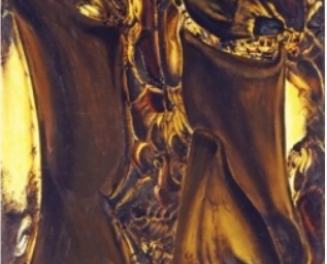
Piotr Potworowski experimented to achieve the most subtle colour solutions: he applied warm undercoats under the layers of cool colours, did not avoid the canvas clearances, used delicate lasers and characteristic paint abrasions - sometimes even scratched with a razor blade and again covered with a thin layer - which gave an interesting effect of "pumice" matter. He sometimes moulded the paint with a spatula or knife, and he often pressed small black elements straight from the tube, creating a convex relief.
Under the influence of matter painting, the painter used the collage technique and enriched his paintings with texture elements. He used to paint on cardboard or the back of old carpets; he glued sacks, pieces of plywood, scraps of raw canvas with thicker or thinner weave, torn off papers and even fishing nets into the composition. An additional element was an accidental, factory inscription, a stamp on canvas or a print on a glued piece of newspaper, which pierced under a thin, colourful laser.
Green was one of the painter's favourite colours, as was the geometric pattern of complementary triangles. With all his courage and innovation, Piotr Potworowski became a racial colourist, a true aesthete. He never gave up his decorative, colourful virtuosity, sophisticated colour combinations, unusual arithmetic of colour, even though he complained that "he is haunted by the cretins of the Capists".
Piotr Potworowski has managed to develop the set design for only 7 productions, but in the opinion of the theatrologists he "showed a new way". His projects broke with traditional illusionism and the architectural construction of the stage - introducing a purely painterly concept: huge prospectuses suspended in the depths of the stage or dropped from the top as the action developed.
In Piotr Potworowski's landscapes, small, black elements play an important role - like magical signs accentuating space.
Piotr Potworowski in Museums:

Poznań: National Museum. You can admire there, among others..:
- „Przed lustrem” namalowany w 1932
- „Krajobraz z Tarragony” namalowany w 1954
- „Schody” namalowany w 1956’
- „Zdarzenie. Kornwalia” namalowany w 1956
- „Zachód słońca w Toskanii” namalowany w 1957
- „Plaża z kamieniami” namalowany w 1957
- „Krajobraz z Łagowa” namalowany w 1958
- „Istota stojąca” namalowany w 1959
- „Dziewczyna siedząca na pasiaku” namalowany w 1959
- „Szary akt” namalowany w 1959
- „Port w Rewie” namalowany w 1960
- „Akt na piaskowym tle” namalowany w 1961-1962
Warsaw: National Museum - Panorama Art Gallery. You can admire there, among others..:
- „Wnętrze lasu: Kornwalia” namalowany w 1952
- „Uliczka w Hiszpanii” namalowany w 1954
- „Dziewczynka z Iraku” namalowany w 1956
- „Niebieski pokój” namalowany w 1958
- „Zachód słońca w Kazimierzu” namalowany w 1958-1959
- „Liściasty krzyż” namalowany w 1959
- „Łuki czarno-zielone. Niedzica” namalowany w 1959
- „Wisła w Kazimierzu” namalowany w 1959
- „Fragment jeziora Łagowskiego” namalowany w 1959-1960
- „Brzeg Wisły” namalowany w 1960
- „Noc dziadów” namalowany w 1961
- „Martwa natura fioletowa” namalowany w 1961

UK:
- Bristol: Royal West of England Academy
Other Polish cities:
- Bytom: Muzeum Górnośląskie. Można tam podziwiać m. in.:
- „Duet” namalowany w 1949
- Kraków: Muzeum Narodowe – Szawerna Art Gallery. Można tam podziwiać m. in.:
- „Szare wnętrze” namalowany w 1955
- „Owalny pejzaż z Kornwalii” namalowany w 1957
- Łódź: Muzeum Sztuki. Można tam podziwiać m. in.:
- „Martwa natura” namalowany w 1930
- „Odaliski – L’hommage à Delacroix” namalowany w 1945
- „Podwórze – wiejska farma” namalowany w 1947
- Szczecin: Muzeum Narodowe. Można tam podziwiać m. in.:
- „Fontanna w Ostii” namalowany w 1959
- Wrocław: National Museum. You can admire there, among others..:
- „Siena” namalowany w 1955
- „Zielony most” namalowany w 1957
- „Cienie balkonów” namalowany w 1958
- Bydgoszcz: Muzeum im. Leona Wyczółkowskiego
- Gdańsk: Muzeum Narodowe
- Kępno: Muzeum Ziemi Kępińskiej
- Katowice: Centrum Scenografii Polskiej
- Lublin: Muzeum Lubelskie
- Opole: Muzeum Śląska Opolskiego
- Toruń: Muzeum Okręgowe
Piotr Potworowski (1898-1962)
- EXCELLENT COLORIST 100%
- LANDSCAPIST 100%
- INNOVATIVE SCENOGRAPHER 95%
- SCULPTOR 100%