
The Great Painters
Piotr Michałowski
- painter of Polish Romanticism

Self-portrait (after 1849), Wikipedia
Piotr Michałowski
(1800-1855)
Surely a few people could share a biography. A landowner, an efficient host, a clerk, a statesman. His true passion was painting - but he preferred civic and economic responsibilities to private passions. In painting, he was practically self-taught, which is why his paintings are so brave, devoid of academic routine. That is why Michałowski's art - alongside Chopin's music and Mickiewicz's poetry - is the most beautiful expression of Polish Romanticism.
BATALIST
EMINENT ANIMALIST
PIONEER OF IMPRESSIONISM
Piotr Michałowski
1800
1814
At the age of 14 he passed the public maturity exam, giving a one-hour speech in Latin... He began his studies at the Jagiellonian University: natural sciences, mathematics and foreign languages.
1821
He continued his studies in Göttingen: law and political science. Drawing was a fun activity, although already then his sketches of horses and troops were gaining recognition
1827
He became head of the Metallurgical Department and mining councilor. He had little time for art - although during his business trips he found time to visit the gallery. In his free time, encouraged by his family, he painted amateurishly.
1831
During the November Uprising he organised the production of weapons for the insurgents. In February that year he married Julia Ostrowska.
1832
After the defeat of the uprising, he had to flee. He went to Paris, where he began regular painting lessons in N. Charlet's studio. Piotr Michałowski has not been keeping up with the orders, his decorative watercolours with horses and sledges are very popular.
1835
his sick father called on him to return and take over the farm. Piotr Michałowski does not hesitate for a moment to put his commitment to his family before his artistic career.
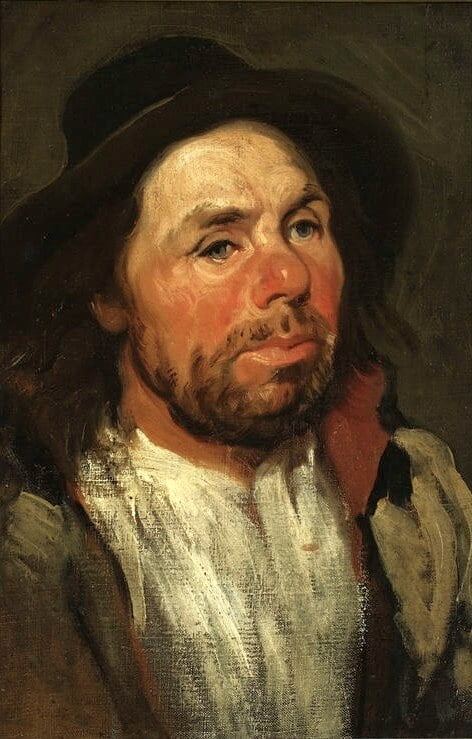
Portrait of a peasant in a hat (around 1846) Wikipedia
1837
After his father's death in April, Piotr Michałowski takes over the estate in Krzysztoforzyce. The stay in the countryside opened another innovative stage in Piotr Michałowski's art. He painted in the open air and his paintings were posed for by local residents: peasants, beggars, Jews.
1845
a return to France, travel abroad, plans for a full return to painting
1848
However, the Spring of Nations and the revolution in Galicia forced him to return. Piotr Michałowski became head of the Administrative Council of the Krakow District. Once again, the citizen of Michałowski won over the artist.
1850
He organized help for fire victims in the great fire of Krakow in 1850, initiated the establishment of a care centre for neglected boys. On this occasion, 4 of his works were put up for charity auction - it was the first public show of his paintings in the country.
1855
Piotr Michałowski was experiencing a recurrence of heart disease, which first appeared several years earlier, after his daughter's death. He died of a heart attack on 9 June in Krzysztoforzyce. He was bid farewell to the Rakowicki Cemetery in Krakow by crowds of inhabitants.
Interesting facts:
The first biography...
Sculpture
Géricault
Cardinal
Piotr Michałowski rarely dated, reworked and painted on abandoned compositions. In "Cardinal" from under a red cape, called mucet, the face of a country girl arranged horizontally clearly shines through.
Slaughterhouses
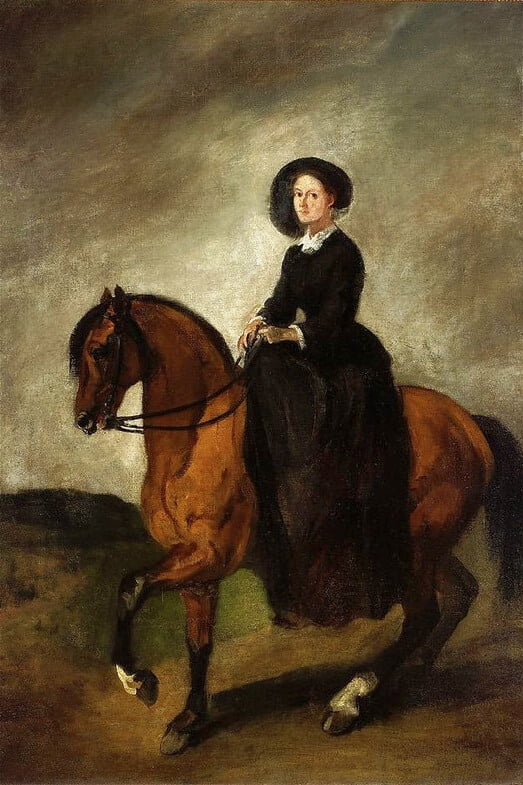
Portrait of the artist's daughter Celina on horseback (about 1853), Wikipedia
About the art of Piotr Michałowski:
He often dressed the surrounding peasants in knightly armour or cardinal red and painted knights, cardinals. The brilliant "Cardinal", formerly known as "The Man in the Birette", is a painting dialogue with the masterpiece of Velázquez - the image of Pope Innocent X.
